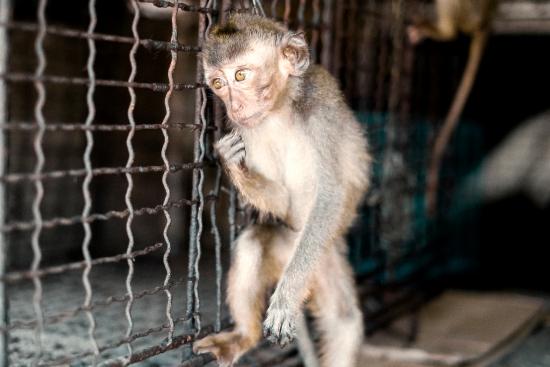
Behind the cold green wires of a cramped cage, two young monkeys sit pressed together, their small bodies curled inward as if trying to disappear. Their eyes—wide, dark, and painfully human—stare out into a world that has already betrayed them. These eyes once knew freedom. They once reflected the open sky, the sway of trees, and the warmth of their mother’s embrace. Now, they reflect fear, confusion, and a silent plea no one seems willing to hear.
They were not born to be merchandise.
Somewhere far from this cage, a forest is missing its voices. Branches no longer tremble with playful leaps. A mother monkey searches endlessly, calling out into the trees, unaware that her children have been stolen by human hands. The capture was likely violent—nets thrown, screams echoing, families torn apart in seconds. For profit. Always for profit.
Inside the cage, the monkeys cling to each other because there is nothing else left. The metal grid cuts the world into cruel squares, limiting not only their movement but their future. Their fingers wrap around the wire instinctively, as if holding on to hope itself, though hope is thin here. They do not understand money. They do not understand trade. They only understand that they are no longer safe.
Wildlife trafficking is one of the quietest forms of cruelty. It happens in shadows, in trucks, in markets where suffering is disguised as business. Animals are reduced to objects, priced, bargained over, sold. Their pain does not factor into the transaction. Their fear does not lower their value. And their lives—fragile, irreplaceable—are treated as expendable.
These monkeys may be sold as pets, condemned to lives of isolation and misunderstanding. A wild animal does not belong in a cage or a living room. Even if fed, even if displayed proudly, their spirit will slowly break. They will grow up without knowing how to survive in the wild, without knowing who they truly are. Their laughter will fade. Their curiosity will turn into anxiety. Their existence will shrink to the size of whatever cage contains them next.
What hurts most is how preventable this suffering is.
Humans pride themselves on intelligence, compassion, and morality, yet scenes like this continue every day. We destroy habitats, steal lives, and then look away. We share photos, shake our heads, and move on—while the cages remain locked. The monkeys wait. And wait. And wait.
If these monkeys could speak, they would not ask for revenge. They would not ask for punishment. They would ask for one simple thing: to go home. To feel the earth beneath their hands instead of metal. To hear the forest instead of silence. To live the life they were born to live.
Their eyes remind us of an uncomfortable truth: the line between human and animal suffering is thinner than we like to admit. Fear looks the same. Loss feels the same. And captivity breaks the soul—no matter the species.
As long as animals are captured and sold, this sadness will repeat itself in endless cages across the world. And every time it does, it asks us a question we cannot ignore forever:
How much longer will we allow innocence to be traded for money?