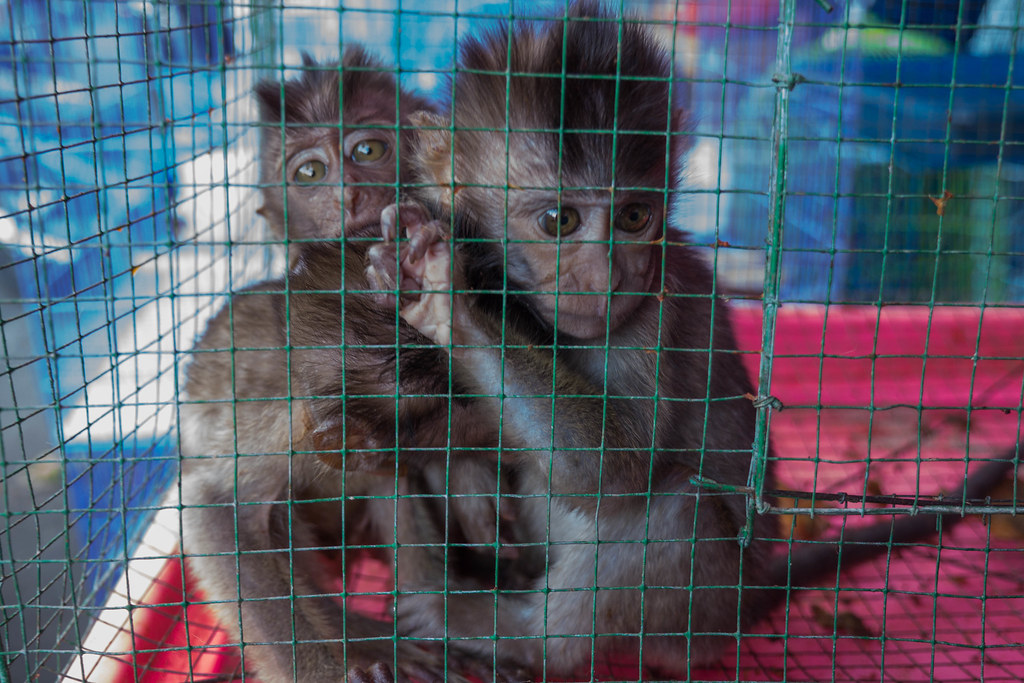
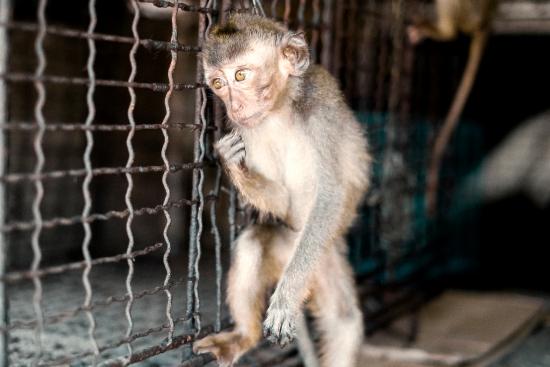
The monkey sits quietly behind the cold metal cage, its small fingers wrapped around the wire as if trying to understand the strange barrier that now separates it from the world. Its eyes, wide and searching, do not carry the mischief or freedom we often associate with wild animals. Instead, they reflect fear, confusion, and a deep, silent sadness. This monkey was once a child of the forest—free to leap from branch to branch, to feel the warmth of the sun through leaves, to live among its family. Now, it is reduced to a commodity, taken from its home and displayed in a city shop as if it were nothing more than an object for sale.
In the forest, this monkey belonged to something greater than itself. The trees were its shelter, the wind its companion, and its family its protection. Every sound had meaning, every movement had purpose. Life there was not easy, but it was natural. The monkey learned when to hide, when to climb, when to play, and when to stay close to its mother. Its world was alive and connected, balanced in a way humans often forget. To be taken from that world is not just a change of place—it is the tearing apart of an entire life.
The capture itself is an act of cruelty that cannot be undone. Imagine the fear as strange humans entered the forest, the panic as the monkey was chased, grabbed, and separated from its family. Imagine the cries of its mother echoing through the trees, unanswered. For animals like monkeys, family bonds are strong and emotional. Losing them is not a small thing. It is trauma. Yet this suffering is invisible to those who only see profit.
Now, in the city, the monkey’s world has shrunk to a cage. The metal wires press close, limiting every movement. The smells are unfamiliar, the noises harsh and constant. Cars, voices, and machines replace birds and rustling leaves. People pass by, staring, pointing, sometimes smiling. Some may feel curiosity, some excitement, but few stop to consider the cost of this moment. For the monkey, each passing day is filled with stress and loneliness. There is no tree to climb, no soft ground beneath its feet, no familiar face to offer comfort.
The sadness in the monkey’s posture tells a story words cannot fully capture. Its body seems tense, as if it is always waiting for something bad to happen again. Its eyes do not shine with joy but with uncertainty. Animals may not speak our language, but they feel pain, fear, and loss deeply. This monkey understands that something precious has been taken away, even if it cannot name it. Freedom, once lost, leaves an emptiness that no cage can fill.
The selling of wild animals in city shops reflects a larger problem: the belief that nature exists only for human use. When animals are treated as decorations or entertainment, their lives are reduced to price tags. This monkey is no longer seen as a living being with needs and emotions, but as an exotic item meant to attract buyers. This mindset is dangerous, not only for animals but for the balance of nature itself. When forests are emptied and wildlife is removed, ecosystems suffer, and eventually, humans do too.
What makes this situation even more painful is how unnecessary it is. Monkeys do not belong in cages or city shops. They do not thrive in isolation or confinement. Even if given food and water, they are deprived of what truly keeps them alive: social bonds, freedom of movement, and a natural environment. Many such animals fall ill, become depressed, or die young. The cost of human curiosity and greed is paid with their lives.
Looking at this monkey, one cannot help but feel pity—but pity alone is not enough. Pity should lead to awareness, and awareness should lead to action. We must question the systems that allow wildlife trafficking to continue. We must choose not to support businesses that profit from animal suffering. And most importantly, we must teach compassion—to see animals not as objects, but as fellow beings sharing this planet.
This monkey’s story is not unique. It represents countless others who have been taken from forests, rivers, and skies, forced into lives they were never meant to live. Each cage holds not just an animal, but a stolen future. If we listen closely, the silence behind those wires is loud with suffering.
Perhaps one day, this monkey will return to the forest, where it belongs. Perhaps it will feel the bark beneath its hands again, hear the familiar calls of its kind, and relearn what freedom feels like. Until then, its eyes ask us a question we cannot ignore: What gives us the right to take everything from those who cannot fight back?
The answer will define the kind of world we choose to live in.