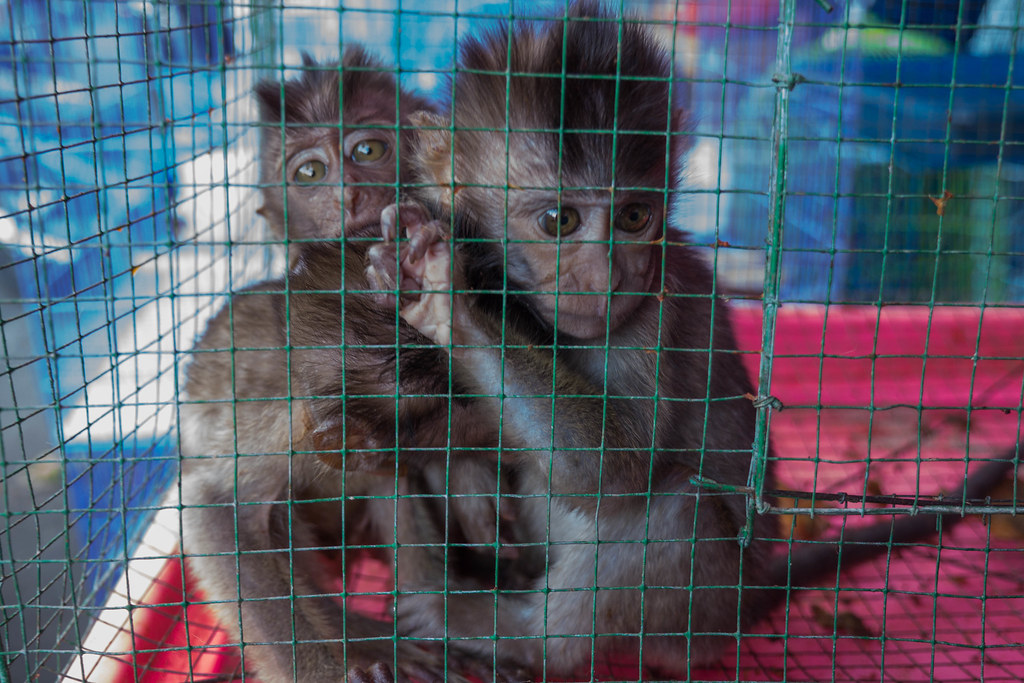
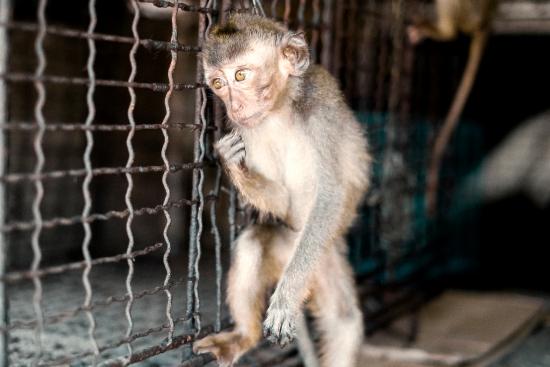
The image of a young monkey, small and wide-eyed, sitting in a cage with a chain around its neck, tells a story that words struggle to hold. Its gaze is not fierce or wild; it is confused, searching, almost pleading. This is not the look of an animal born into captivity. It is the look of a child taken too soon from home.
Somewhere beyond the metal bars and concrete floors, there was once a forest. In that forest, this young monkey clung to its mother’s fur, learned the language of leaves and branches, and understood safety as the warmth of family. Monkeys are deeply social beings. Their lives revolve around complex bonds—mothers nurturing infants, elders teaching survival, siblings playing and testing the world together. To be born a monkey is not just to exist alone, but to belong.
When a baby monkey is stolen from the wild, that belonging is violently torn apart.
The capture rarely happens gently. Poachers often hunt adult monkeys first, because parents will fight fiercely to protect their young. Infants are pulled from the arms of dying or injured mothers, their cries echoing through the trees. These sounds—sharp, desperate—are alarm calls meant to summon help that never comes. What follows is shock. A baby monkey cannot understand why the familiar heartbeat it relied on is suddenly gone.
In the image, the monkey is surrounded by others like it, all confined, all chained. This suggests a system, not an accident. The illegal wildlife trade thrives on turning living beings into commodities. Young monkeys are especially prized because they are easier to handle, easier to sell, and more appealing to buyers seeking exotic pets or props for entertainment. Their youth makes them profitable—and disposable.
What we do not see in the image is just as important as what we do. We do not see trees swaying in the wind, or the mother calling out to her lost child. We do not see the forest paths the monkey would have learned by memory, or the fruits it would have tasted as seasons changed. Captivity erases all of this, replacing a rich, sensory world with repetition, fear, and restraint.
For a young monkey, captivity is not merely physical imprisonment. It is psychological trauma. Monkeys develop intelligence through exploration and social interaction. Deprived of these, many suffer from stress behaviors—rocking, self-harm, aggression, or withdrawal. Chains and cages do not just limit movement; they slowly break the mind.
There is also the quiet cruelty of loneliness. Even when other monkeys are nearby, captivity disrupts natural social structures. Families are not intact. Bonds are fractured. Trust becomes difficult in an environment defined by force and unpredictability. The monkey in the foreground seems isolated even among others, its posture tense, its eyes too alert for one so young.
This suffering is invisible to many people because it happens far away, deep in forests or behind closed doors in markets and private homes. The wildlife trade often disguises itself with excuses—claims of rescue, breeding, or cultural tradition. But the reality is simple: wild animals belong in the wild. No cage, no matter how clean or large, can replace a forest.
The loss is not only personal to the monkey. It is ecological. Monkeys play vital roles in forest ecosystems, dispersing seeds and helping maintain biodiversity. When young monkeys are removed, forests lose future caretakers. Over time, this weakens entire ecosystems, affecting countless other species, including humans who depend on healthy forests for clean air, water, and climate balance.
Yet this story does not have to end in despair.
Around the world, conservationists, rescue centers, and local communities are working to stop wildlife trafficking and rehabilitate stolen animals. When rescued early enough, some young monkeys can be reintroduced to protected habitats, taught again how to forage, climb, and socialize. It is a long, delicate process that requires patience, funding, and compassion—but it offers hope.
Hope also lies with us. Every decision matters: refusing to support exotic pet ownership, questioning entertainment that uses wild animals, supporting organizations that protect habitats and enforce wildlife laws. Awareness is powerful. When we choose empathy over novelty, protection over profit, we help prevent images like this from becoming the norm.
The young monkey in this picture did not choose this fate. It did not wander into human spaces or ask to be taken. It was born into a forest, into a family, into a life that made sense for its species. What we see in its eyes is the cost of forgetting that other beings have homes, relationships, and rights to exist beyond our control.
To pity this monkey is human. To protect the next one is our responsibility.