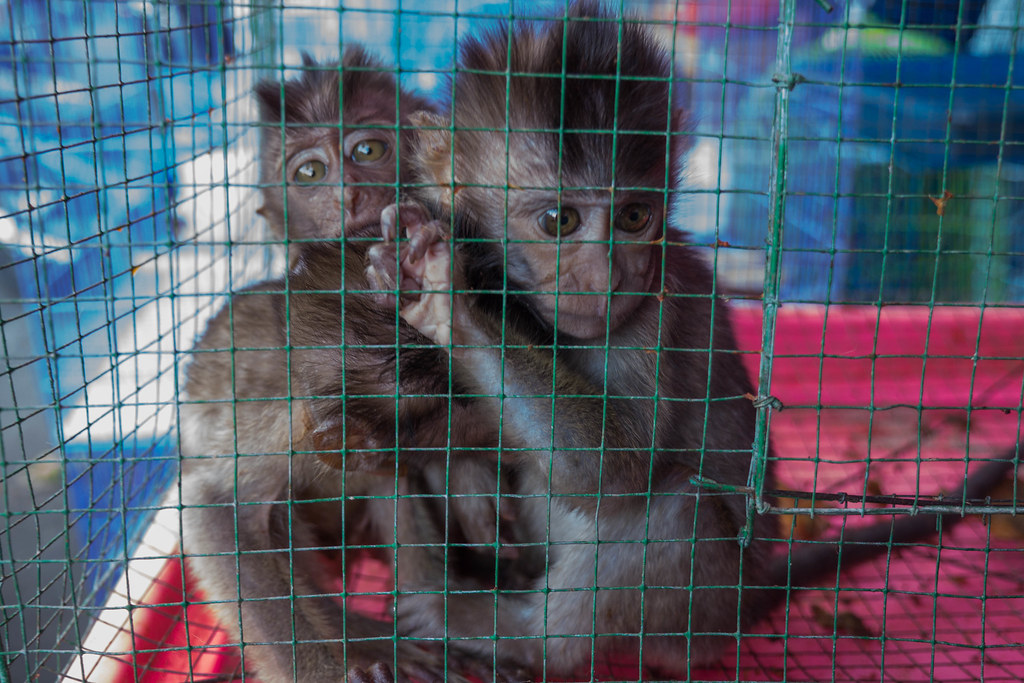
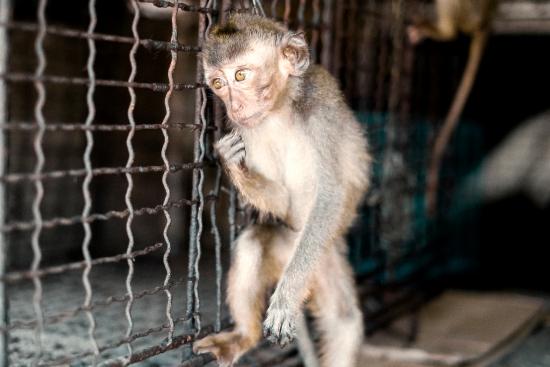
In a world filled with noise, movement, and constant change, there exists a sorrow so quiet that it is often ignored. It is the sorrow of a life too small to speak, too weak to resist, and too innocent to understand why it has been abandoned by fate. The image of a baby monkey being fed milk from a bottle by a human hand is not simply a picture of care—it is a portrait of loss, loneliness, and irreversible separation. This baby monkey is an orphan, stripped of its parents before it ever had the chance to know what safety truly meant.
The baby monkey’s body is frail, its limbs thin and trembling, as though the weight of the world has already pressed down upon it. Its eyes are half-closed, exhausted, carrying a sadness far deeper than physical hunger. Milk drips gently from the bottle, sustaining its fragile body, yet no amount of nourishment can replace what it has lost. The warmth of a mother’s embrace, the protection of a father’s presence, and the comfort of belonging to a family are gone forever.
This baby monkey was not meant to grow up like this. In the wild, its life should have begun with love written into instinct. It should have clung tightly to its mother’s fur, feeling her heartbeat as its first sense of security. It should have learned the sounds of the forest, the language of survival, and the meaning of trust through its parents. Instead, its first lessons are hunger, fear, and loneliness.
Orphanhood is a heavy word, even among humans. But for a wild animal, being orphaned is often a death sentence. Without parents, there is no guidance, no protection from predators, no knowledge passed down through generations. This baby monkey does not understand why its parents are gone. It does not know whether they were killed, captured, or forced to abandon it. All it knows is absence. An absence that echoes in every breath it takes.
The human hand holding the bottle represents compassion, but it also represents tragedy. Humans have stepped in to save this baby monkey because something went terribly wrong. Nature did not fail this child—human actions did. Deforestation, illegal wildlife trade, habitat destruction, and careless violence have torn families apart in silence. The baby monkey is a victim of choices made far away, by people who will never see its face or feel its suffering.
As the milk flows into its mouth, the baby monkey drinks slowly, weakly, as if each swallow requires effort. Its tiny body fights to stay alive, even though its spirit is already burdened with grief. There is no joy in this moment, only survival. This is not nourishment shared between mother and child; it is an emergency response to loss.
The sadness of this image lies not only in what we see, but in what we cannot see. We cannot see the mother searching desperately through the forest, calling out for her baby. We cannot see the father standing guard against danger, now absent from his role. We cannot see the family unit that once existed, now shattered beyond repair. Their stories end where this one begins—with a baby left alone in a world too large and too cruel.
The baby monkey’s eyes tell a story that words cannot. They reflect confusion, exhaustion, and a quiet question that will never be answered: Why am I alone? It does not know what death is. It does not understand human greed or destruction. It only knows that the arms that once held it are gone, replaced by unfamiliar hands and a cold sense of uncertainty.
Being orphaned robs this baby monkey not only of love, but of identity. It will grow up without learning the natural behaviors passed down from its parents. It may never fully understand how to live freely in the wild. Even if it survives, its life will always be shaped by loss. Survival, in this case, does not mean healing—it means enduring.
There is something deeply heartbreaking about seeing a wild animal dependent on humans for survival. Wildness is meant to be free, guided by instinct and family bonds. When those bonds are broken, the soul of the animal suffers, even if the body survives. The baby monkey’s life now exists between two worlds: the wild it no longer belongs to and the human world it never chose.
This image forces us to confront an uncomfortable truth: compassion often arrives too late. We rescue the orphan after the damage has already been done. We feed the baby after the parents are gone. We feel sadness only after the family has been destroyed. The bottle of milk becomes a symbol of both kindness and guilt—a reminder that saving one life does not erase the suffering that led to its condition.
The baby monkey’s future is uncertain. It may grow stronger, but it will carry invisible scars. It may live, but it will never truly be whole. There will always be something missing—something that cannot be replaced by care, medicine, or time. The absence of parents is not a wound that heals; it is a silence that remains.
This orphaned baby monkey represents countless others who never receive help. For every rescued orphan, many more die unseen, unheard, and unmourned. Their lives fade quietly into the soil of destroyed forests, leaving no trace behind. This single image stands as a witness to all of them.
As humans, we must ask ourselves difficult questions. Why do such tragedies continue to happen? Why do we allow destruction to outweigh compassion? Why do innocent lives pay the price for profit and convenience? The baby monkey cannot ask these questions, but its suffering demands that we do.
The sadness of this image stays with us because it reflects our own vulnerability. Like this baby monkey, we all begin life needing care, protection, and love. When those are taken away, the damage is profound. In its orphaned state, we see a reflection of universal pain—the pain of losing those we depend on most.
In the end, this image is not just about a baby monkey. It is about responsibility. It is about the consequences of human actions on lives that cannot defend themselves. It is about the quiet suffering that continues every day beyond the reach of our attention.
The baby monkey drinks from the bottle, unaware of the meaning of its own survival. It does not know whether tomorrow will bring safety or more loss. It lives moment by moment, guided only by instinct and the fragile kindness of strangers. Its life is a question mark written in flesh and bone.
This orphaned child of the forest did not choose its fate. Yet it must live with it. And as long as such images exist, we are reminded that compassion should not begin after tragedy—but before it. Until that day comes, orphaned lives like this baby monkey’s will continue to bear the silent weight of a world that failed them.