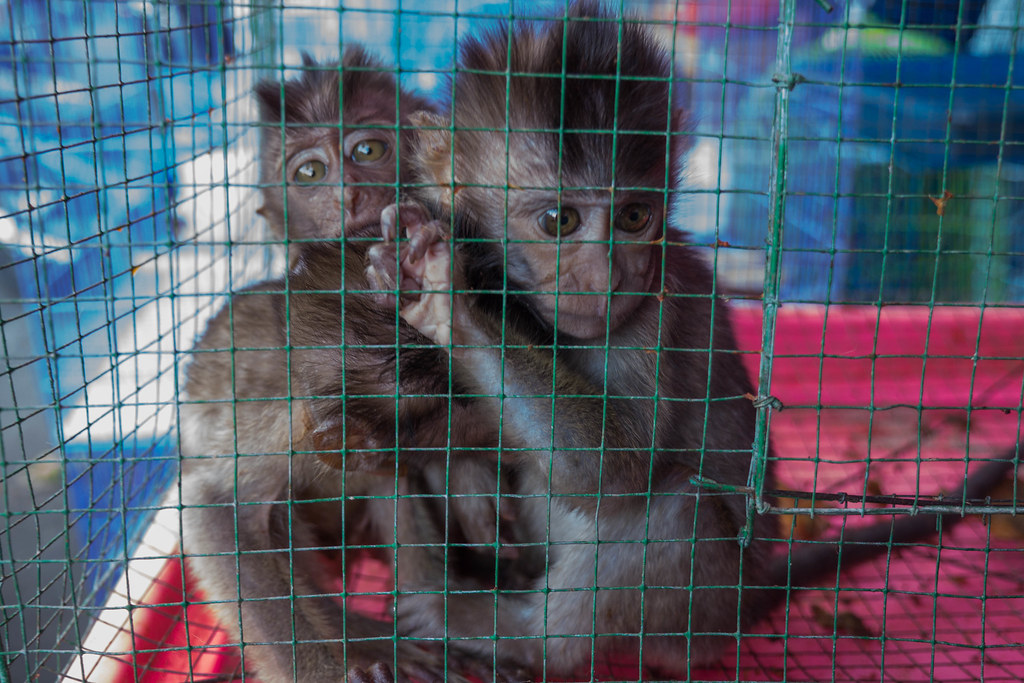
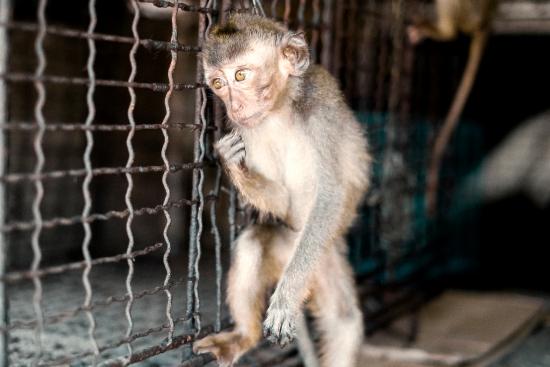
In the middle of a quiet, ordinary day, there exists a moment so fragile that it almost feels unreal. A tiny monkey sits inside a shallow woven basket, its body barely large enough to fill the space meant to protect it. Its eyes are wide, dark, and glistening—not with joy, but with a confusion too heavy for such a small creature to carry. A human hand gently holds a bottle of milk to its mouth, an act of kindness that feels both comforting and heartbreaking at the same time. This single image captures a story of loss, vulnerability, and survival, reminding us how cruel and indifferent the world can be to the weakest lives within it.
The baby monkey drinks desperately, clinging to the bottle as though it were the last thread tying it to existence. Its tiny fingers curl instinctively, driven by hunger and fear rather than understanding. This is not the way life was meant to begin for a wild creature. Somewhere beyond the frame of this photograph lies an invisible tragedy—a mother missing, a forest disrupted, a family torn apart. The basket may hold the monkey’s body, but it cannot contain the grief hidden behind its innocent eyes.
This young life was meant to grow among trees, to cling to its mother’s warm fur, to learn the rhythm of the forest through her movements. It should have known the safety of her heartbeat, the reassurance of her presence, and the quiet lessons passed down through instinct. Instead, it knows the cold touch of separation. The milk bottle replaces what nature intended, and while it sustains the body, it cannot fill the emptiness left by loss.
There is something profoundly sorrowful about seeing a wild animal dependent on human care. It is a silent admission that something has gone terribly wrong. The monkey does not understand why its world has changed. It does not know the meaning of destruction, deforestation, or human interference. It only knows that the warmth it once relied on is gone, replaced by unfamiliar hands and strange surroundings. Its confusion is written across its face, a question it cannot ask: Why am I alone?
The woven basket, humble and fragile, becomes a symbol of temporary safety in an unsafe world. It is not a home. It is not a forest. It is merely a pause between danger and survival. The ground beneath it is wet, littered with fallen leaves—remnants of nature that whisper of a home that once was. These leaves may have fallen from trees similar to the ones the monkey should have been climbing, trees that may no longer stand.
As humans, we often praise ourselves for moments of compassion like this—feeding, rescuing, protecting. And while these actions are undeniably kind, they also force us to confront an uncomfortable truth: our kindness is often needed because of harm caused by our own species. The baby monkey does not need milk from a bottle because nature failed it. It needs it because nature was interrupted.
The sadness of this image lies not only in the monkey’s vulnerability but in its silence. It cannot cry out in words. It cannot explain its pain or demand justice for what it has lost. Its suffering is quiet, easily overlooked, and painfully common. How many other creatures like this one exist beyond the reach of cameras? How many small lives fade away unnoticed, without a basket, without milk, without a helping hand?
The monkey’s eyes seem to search for something beyond the bottle—perhaps a memory it cannot fully grasp, or a comfort it instinctively knows should exist. There is an ancient sadness in those eyes, as though they carry the weight of generations disrupted by forces beyond their control. In that gaze, we see the cost of progress, the price paid by the voiceless when land is cleared, forests are burned, and habitats are destroyed.
This image also challenges our understanding of innocence. The monkey has done nothing to deserve this fate. It has committed no wrong, made no choice. And yet, it must struggle to survive in a world that has already failed it. Its tiny body bears the burden of human decisions made far away, by people who will never see its face or feel its quiet pain.
There is a cruel irony in the tenderness of the moment. The hand feeding the monkey is gentle, careful not to harm. Yet the same species that shows this care is responsible for the circumstances that made it necessary. This contradiction sits heavily in the heart, forcing us to question what true compassion really means. Is it enough to save one life while countless others continue to suffer? Or does compassion demand something deeper—something that prevents such suffering from happening in the first place?
The baby monkey drinks, unaware of the future that awaits it. Will it survive? Will it grow strong enough to return to the wild? Or will it live its life in captivity, safe but forever separated from the freedom it was born to know? Each possibility carries its own sorrow. Survival does not always mean healing, and safety does not always mean happiness.
There is also grief in the unseen mother. Somewhere, perhaps injured or dead, perhaps searching endlessly, she may still be calling out for the child she lost. Nature does not easily accept separation. Bonds formed in the wild are deep and instinctual, and when they are broken, the pain resonates far beyond what we can see. This image captures only one side of that grief, leaving the rest to our imagination.
As we look at this small creature, we are forced to confront our responsibility. Not just as individuals, but as a collective. The monkey’s story is not an isolated one. It is a reflection of a larger pattern—a world where the weak suffer quietly while the powerful move forward without looking back. It reminds us that survival should not require such suffering, and that innocence should not be punished by circumstance.
The sadness of this image lingers long after we look away. It stays with us because it speaks to something deeply human: the fear of abandonment, the need for care, and the pain of loss. In the monkey’s fragile form, we see our own vulnerability reflected back at us. We are reminded that life, in all its forms, is delicate and easily broken.
Perhaps the greatest tragedy is that this scene feels familiar. We have seen versions of it before—different animals, different places, the same quiet despair. And yet, each time, it still hurts. Because deep down, we know that this should not be normal. A baby, of any species, should not have to fight so hard just to exist.
In the end, the image does not ask for pity. It asks for awareness. It asks us to slow down, to feel, and to remember that every small life matters. The baby monkey in the basket is more than a subject of a photograph. It is a reminder—a fragile, heartbreaking reminder—of what is at stake when compassion comes too late, and of the silent suffering that continues when we choose not to look.